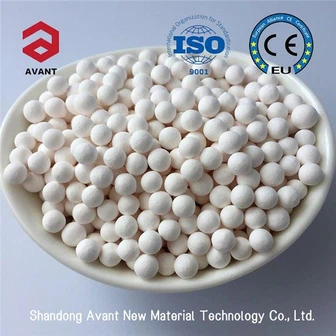
introduction of alumina ceramic production process
one Features and technical indicators
Alumina ceramics are currently divided into two types: high purity type and common type. High-purity alumina ceramics are ceramic materials with Al2O3 content above 99.9%. Due to its sintering temperature as high as 1650-1990℃ and transmission wavelength as high as 1~6 m, they are generally made of fused glass to replace platinum crucible: using its light transmittance and alkali resistance metal corrosion as sodium lamp tube; In the electronics industry, it can be used as integrated electric subgrade board and high frequency insulation material. Ordinary alumina ceramic system is divided into 99 porcelain, 95 porcelain, 90 porcelain, 85 porcelain and other varieties according to the content of Al2O3, sometimes Al2O3 content in 80% or 75% also classified as ordinary alumina ceramic series.
The hardness of rockwell is hRA80-90, which is second only to diamond, and far exceeds the wear resistance of wear-resisting steel and stainless steel.
2. Excellent wear resistance
The wear resistance is 266 times as much as that of manganese steel and 171.5 times as much as that of high-chromium cast iron. According to our customer tracking survey over the past ten years, the service life of the equipment can be extended at least ten times under the same working condition.
3. Light weight
Alumina ceramic density is 3. 5g/cm3, only -half of steel, which can greatly reduce equipment load. Main technical indicators of abrasion resistant ceramics: alumina content ≥95%, density ≥3.5g/cm3, Rockwell hardness ≥80 HRA, compressive strength ≥850 Mpa, fracture toughness K IC≥ 4.8mpa ● M1 /2, bending strength ≥290MPa, thermal conductivity 20W/m.K, thermal expansion coefficient: 7.2x10⁻⁶m /m.K.
Ii. Powder preparation:.
The aluminum oxide powder is prepared into powder material according to different product requirements and different molding processes. The particle size of the powder is below 1 m micron. In addition to the purity of alumina in 99.99%, the high-purity alumina ceramic products also need to be ultrafine crushed to make the particle size distribution uniform. When using extrusion molding or injection molding, the binder and plasticizing agent should be introduced into the powder, generally thermoplastic plastic or resin with a weight ratio of 10-30%. The machine binder should be mixed evenly with the alumina powder at 150-200 ℃ to facilitate the molding operation. There is no need to add binder for powder material formed by hot pressing process. If semi-automatic or full-automatic dry pressing is adopted, it has special technological requirements for the powder. Spray granulation method is needed to treat the powder and make it appear spherical, so as to improve the fluidity of the powder and facilitate the automatic filling of the mold wall during the molding. In addition, in order to reduce the friction between powder and mold wall, 1~2% lubricant, such as stearic acid and binder PVA, should be added.
It is necessary to spray the powder for dry pressing molding, in which polyvinyl alcohol is introduced as binder. In recent years, a water-soluble paraffin wax was developed by a research institute in Shanghai as a binder for spray granulating Al2O. It has good fluidity under heating conditions. After spray granulation, the powder must have good fluidity, loose density and flow Angle friction temperature less than 30C. The particle size ratio is ideal to obtain the larger density of the green billet.