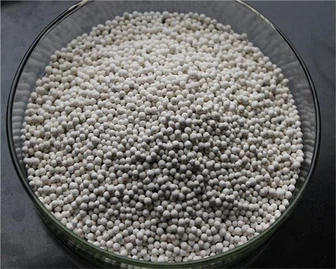
Composition of reforming catalysts
Modern reforming catalysts consist of a basic active component (e.g. platinum, palladium, iridium, rhodium), a co-catalyst (e.g. rhenium, tin etc.) and an acidic carrier (e.g. γ-Al2O3 containing halogens ).
1. Metal components
Pt catalysts have the highest dehydrogenation activity among the reforming catalysts; Pt is very expensive and is therefore highly dispersed in Pt catalysts with a content of 0.20% - 0.75% in crystalline form, with an average Pt grain diameter of 0.8 - 10 mm; the smaller the grain size, the larger the contact surface between Pt and the carrier, and the higher the catalyst activity and selectivity. To prepare highly dispersed Pt catalysts, Al2O3 is often impregnated into Al2O3 in the form of H2PtCl6 solution or exchanged into Al2O3 in the form of [Pt(NH3)4]2+. The preparation process also affects the grain size, e.g. high roasting temperatures result in larger grains. Grain size can be indirectly reflected by the metal dispersion, which is defined as.
Pt dispersion = amount of adsorbed hydrogen atoms / amount of total Pt atoms
The Pt dispersion in good reforming catalysts can reach 0.95. The Pt dispersion in single Pt catalysts decreases with time and the addition of elements such as Re, 1r. Pd. Sn, Ti, A etc. helps to maintain the original high dispersion of Pt.
2. Acidic component - halogens
The acidic centre of the reforming catalyst is mainly provided by halogens. As the halogen content increases, the catalytic activity of the catalyst increases for acidic reactions such as isomerisation and hydrocracking. There are usually two types of halogens used, fluorine-chlorine and all-chlorine types. Fluorine is more stable on the catalyst and is less likely to be carried away by water during operation, but the hydrocracking properties of fluorine are stronger, making the catalyst less selective. Chlorine is unstable on the catalyst and is easily carried away by water, which is just as well as being able to maintain the appropriate chlorine content on the catalyst during process operation by injecting chlorine and water according to the water-chlorine balance in the system, and by chlorination after catalyst regeneration.
Therefore, in recent years, the full chlorine type has mostly been used. Generally fresh full chlorine catalysts contain 0.6% to 1.5% chlorine and in practice a stable chlorine content of 0.4% to 1.0% is required. If the halogen content is too low, the aromatic conversion is low (especially for five-membered cycloalkanes and alkanes) or the octane value of the resulting oil is low due to insufficient acidic functionality. Although increasing the reaction temperature can compensate for this effect, increasing the reaction temperature can significantly reduce the catalyst life. Hydrocracking reactions are enhanced by too high a halogen content, resulting in lower yields of liquid products.
3. Carriers
Generally speaking, the carrier itself is not catalytically active, but has a large specific surface area and good mechanical strength, which allows the active components to be well dispersed on its surface and thus play their role more effectively, saving the amount of active components and improving the stability and mechanical strength of the catalyst. Modern reforming catalysts almost always use γ-Al203 as a carrier, whose main role is to support (load) the active component and to form an acidic function together with chlorine.
The carrier should have a suitable pore structure. Too small a pore size is not conducive to the diffusion of raw materials and products, and it is easy to coke at the mouth of the micro-pore, so that the inner surface cannot be fully utilised and the catalyst activity decreases rapidly. In recent years the pore distribution of γ-Al203 used as a catalytic carrier for reforming has tended to concentrate, with a significant reduction or even elimination of micropores with a pore size of less than 4m. Most of the carriers are in the shape of small spheres or cylinders with diameters of 1.5-2 5mm, but also in the shape of shaped strips and turbines in order to improve mass transfer and reduce the pressure drop in the bed.
Stack densities of reforming catalysts are mostly in the range of 600-800 kg/m3. In recent years, the stacking density of the carrier has tended to increase, so that the stacking density of reforming catalysts is generally above 700 kg/m2.