

Ceramics--16 Molding Processes(Full Version)
This article Avant will continue to describe the complete "Ceramic Molding Process".
7. Calendering.
The powder, additives and water are uniformly mixed to make plastic material, and then the material is rolled by two oppositely rotating rolls, thereby becoming a forming method of plate-shaped china. The green body obtained by rolling film forming has high density and is suitable for the forming of sheet-like and plate-like objects.
8. Grouting.
The grouting method is to inject the prepared mud into the gypsum model. Because the gypsum model has the properties of air permeability and water absorption, after the mud contacts the model, the water in the mud will be gradually sucked into the model wall, and the fine particles in the mud will follow the model. When the thick mud layer reaches the expected thickness, the excess mud in the model can be poured out. After the moisture in the thick mud layer is continuously absorbed by the model to achieve independent molding, the green body can be taken out and dried for repair.
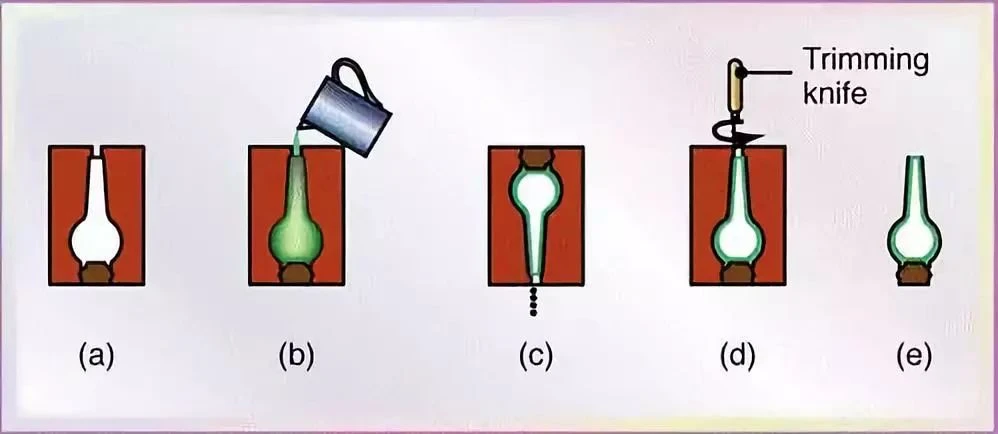
Advantages: low process cost, simple process, easy operation and control.
Disadvantages: rough molding shape, long grouting time, and low density and strength of the green body.
9. Centrifugal Grouting.
Centrifugal grouting is developed on the basis of traditional grouting. By adjusting the pH value and other process parameters, the powder is uniformly dispersed in the liquid, and deposited and formed under the action of the centrifugal force of high-speed rotation. Centrifugal grouting combines wet chemical powder preparation with stress-free densification technology. On the one hand, it can prevent powder agglomeration and other defects; It can be used for the preparation of multi-layer and gradient composite functional materials.
10. Electrophoretic Deposition Molding.
Electrophoretic deposition molding is to use a DC electric field to promote the migration of charged particles, and then deposit them on electrodes with opposite polarities.
Features: Simple operation, flexibility and high reliability, so it is suitable for the molding method of multilayer ceramic capacitors, sensors, and gradient functional ceramics, but it is sensitive to changes in process parameters.

11. Gel Injection Molding.
Injection molding is to add vinyl organic monomers in the suspension medium, and then use catalysts and initiators to cross-link the organic monomers through free radical reaction, and the green body is cured in situ. Gel injection molding technology is a new colloidal rapid prototyping process first invented by researchers at Oak Ridge National Laboratory in the early 1990s.
Advantages: The green body has high strength and is easy to machine.
Disadvantages: The shrinkage rate of the green body is relatively large during the densification process, resulting in bending and deformation of the green body, and the organic monomers used are toxic, and the reaction atmosphere is not easy to control.
12. Tape Casting.
Tape casting refers to a molding method in which solvent, dispersant, binder, plasticizer and other components are added to ceramic powder to obtain a uniformly dispersed and stable slurry, and a film of the required thickness is obtained on a casting machine.

Advantages: simple equipment, continuous operation, high production efficiency, high automation level, stable process, uniform green body performance, etc.
13. Direct Solidification.
Direct solidification molding is a new concept of net size in situ ceramic molding technology invented in the 1990s by Professor Gauckler's research group at the Swiss Federal Institute of Technology in Zurich, which combined biological enzyme technology, colloidal chemistry and ceramic technology.
Advantages: no or only a small amount of organic additives (less than 1wt%) is required, the green body does not need to be degreasing, the green body density is uniform, the relative density is high, and large-sized and complex-shaped ceramic parts can be formed.
Disadvantages: The green body strength is often not high enough.
14. Colloidal Vibration Injection Molding.
Colloidal vibration injection molding is a colloidal molding technology invented in 1993 by Professor F.F. Lange of the University of California, Santa Barbara. The prepared dilute suspension containing high ionic strength (20% to 30% (vol)) is filtered or centrifuged to obtain a high solid content blank, and then poured under the action of vibration to achieve in-situ curing.
Advantages: Continuous production can be achieved, and ceramic parts of complex shapes can be formed.
Disadvantages: The green body has low strength, and the green body is easy to crack and deform when demoulding.
15. Temperature Induced Flocculation.
Temperature-induced flocculation molding is a net-size colloidal molding method invented by Sweden L. Bergstrom in 1994. DCC and colloidal vibration injection molding utilize the electrostatic stability of colloids and this method utilizes the space (steric hindrance) of colloids. Stable characteristics.
Advantages: Unqualified green bodies can be reused as raw materials after demolding, and can be used to shape almost all ceramic powder systems.
16. Solid Moldless Molding.
The concept of modern solid moldless molding technology appeared around the end of the 1970s. In the early 1990s, the University of Texas proposed the idea of free-form manufacturing and applied it to the field of ceramics. Solid moldless molding technology breaks through the limitations of traditional molding ideas and is a "growth" based molding method. In the field of ceramics, solid moldless molding processes can be further divided into: laser selective sintering molding, 3D printing molding, fused deposition molding, layered manufacturing molding, stereolithography molding, etc.
Features: high flexibility, high integration of technology, rapidity, free-form manufacturing, etc. The current main problems of this technology are: high equipment price, software development, material development, forming accuracy and quality.


