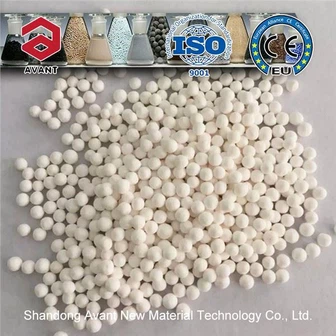
Alumina polishing liquid abrasive and its stability
Chemical Mechanical Polishing (CMP) technology is a surface Polishing technology for global flattening, and Polishing Polishing fluid is a key factor in CMP technology. The polishing fluid is mainly composed of abrasive, solvent and additive, and its types, properties, particle size, particle dispersion and stability are closely related to the final polishing effect.
At present, the most widely used abrasive materials in the market are SiO2, CeO2 and Al2O3. Among them, SiO2 polishing solution has good selectivity and dispersity, good mechanical abrasion performance, lively chemical properties, and easy post-cleaning process treatment. The disadvantage is that gel is easy to be produced in the polishing process and the polishing rate of hard bottom material is low. CeO2 polishing solution has the advantages of high polishing rate and material removal rate. Disadvantages are high viscosity, easy to scratch, and poor selectivity, subsequent cleaning difficult. The disadvantages of Al2O3 polishing solution are low selectivity, poor dispersion stability, easy agglomeration, etc., but it has an excellent removal rate for hard substrate such as sapphire substrate.
A brief introduction to Al2O3 polish
The hardness of -alumina (corundum) is high and the stability is good. The nano-alumina is suitable for the precision polishing of optical lens, single-core fiber connector, microcrystalline glass substrate, crystal surface and so on. It is widely used. At present, the semiconductor lighting technology with high brightness Gan-based blue light LED as the core has caused a great sensation in the lighting field and become a hot spot in the research of semiconductor field in the world. However, GaN is difficult to be prepared, and epitaxial films must be grown on other substrate chips, such as sapphire chips or silicon carbide chips, so the polishing of the chips has also become the focus of attention.
In recent years, a new process has been adopted internationally, which USES Al2O3 polishing solution to finish the grinding and polishing of sapphire and silicon carbide wafers once, greatly improving the polishing efficiency. However, due to the high hardness of nano-alpha-alumina, it is easy to cause serious damage to the workpiece surface during polishing. Moreover, the surface energy of nano-alumina is relatively high, and the particles are easy to agglomerate, which will also cause surface defects such as scratches and pits of polishing workpiece. In recent years, the research of alumina polishing fluid mainly focuses on the preparation of nano-abrasive, surface modification of alumina particles, mixing application of alumina polishing fluid and so on.
Preparation of Al2O3 polishing solution abrasive
Alumina abrasives used in chemical mechanical polishing are usually nano--AL2O3 with high hardness, stable performance, insoluble in water and insoluble in acid and alkali. As chemical-Mechanical polishing abrasive, the size, shape and particle size distribution of alumina particles all affect the polishing effect. In the LED industry, nano--Al2O3 with uniform particle size distribution of 50-200 nm is often used in CMP polishing solution. In recent years, the research on -Al2O3 abrasive particles mainly focuses on the preparation of nanoscale spherical particles. The common preparation methods are as follows.
The solid phase method. Among them, aluminum ammonium sulfate pyrolysis, improved Bayer method and explosion method are relatively mature preparation methods. The process of preparing ultrafine powder by solid phase method is simple, no solvent is needed, and the yield is high. However, the generated powder is easy to agglomerate, and the particle size is not easy to control, so it is difficult to get the high quality nanometer powder with uniform distribution and small particle size.
The gas phase method. There are mainly chemical gas phase precipitation, through heating and other ways to change the form of matter, in the gas state reaction, and then formed in the cooling process particles. The advantages of gas phase method are that the reaction condition can be controlled, the product is easy to be refined, the particle dispersity is good, the particle size is small, the distribution is narrow, but the yield rate is low, the powder is difficult to collect.
Liquid phase method. Common hydrolysis, spray drying, sol gel, emulsification and other methods. The advantages of liquid phase method are as follows: the chemical composition of products can be accurately controlled, the surface activity of nanoparticles is high, the shape is easy to control and disperse evenly, the production cost is relatively low, and it is easy to realize industrial production.
Methods to improve the stability of Al2O3 polishing solution
In recent years, with the development of LED industry and the increase of gem substrate demand, alumina polishing fluid has a good application prospect in sapphire polishing fluid with high polishing rate. However, alumina polishing fluid has poor dispersion stability during the polishing process, and it is easy to condense during the polishing process, causing scratches on the polished surface. Many researchers have studied how to improve the stability of alumina polishing fluid.
In polar aqueous solution, alumina nanoparticles are prone to flocculation and stratification due to electrostatic forces, which will damage the dispersion and stability of the polishing solution. The large particle micelles produced by the agglomeration of abrasive particles are the main cause of the scratches on the substrate surface during CMP. The size and distribution of alumina particles, Zeta potential, the addition of stabilizer, the type and quality of dispersant have great influence on the stability of the polishing solution.
Nano-alumina surface modification can improve particle surface regularity, reduce polishing scratches and pits, and improve alumina abrasive dispersion and polishing fluid stability. The common treatment method is to use coupling agent, organic matter, inorganic matter and so on in the hardness of the surface of alumina particles coated with a softer material to reduce polishing scratches and pits and other defects, so as to improve the stability and dispersion of the alumina polishing solution, while effectively improve the abrasion resistance of the polishing abrasive. In addition, the stability of the polishing solution can be improved by changing Zeta potential of alumina particles.
Problems with Al2O3 polishing solution
Dispersion of abrasive particles. At present, ultrasonic wave, mechanical agitation, surface treatment and other mechanochemical methods are commonly used at home and abroad to disperse nano-abrasive particles, but often fail to achieve the effect. Therefore, the dispersion stability of nano-abrasive particles needs further study.